
Destinations · The Society Pages
Lisbon: Príncipe Real and the Soft Queer Welcome
Not Madrid's scale. Not Berlin's edge. Lisbon is the quiet queer city where you can just *be*. Year-round.
Hello, Darlings.
Lisbon is the European queer destination most luxury travelers haven’t discovered yet. Not Madrid’s WorldPride scale. Not Berlin’s edge. Not the Pride-destination calendar that dominates Mykonos and Tel Aviv.
Lisbon is softer.
The gay neighborhood is Príncipe Real — a hilltop district in the city center with botanical gardens, design shops, independent cafés that shift from morning coffee to evening drinks, small galleries, and a queer presence that’s integrated rather than declared. You’ll see same-sex couples holding hands on the streets like they belong there — because they do. The restaurants don’t perform Pride; they assume queerness. The culture is welcoming not because Lisbon is marketing itself, but because Lisbon is genuinely that.
The city’s queer-friendliness is sustained year-round. There’s no Pride-season surge where you have to be there in July. You can be there any month and the cultural default is the same: queer life is unremarkable and celebrated. That changes the entire energy of the trip.
The Two Lisbons (Which One Is Yours)
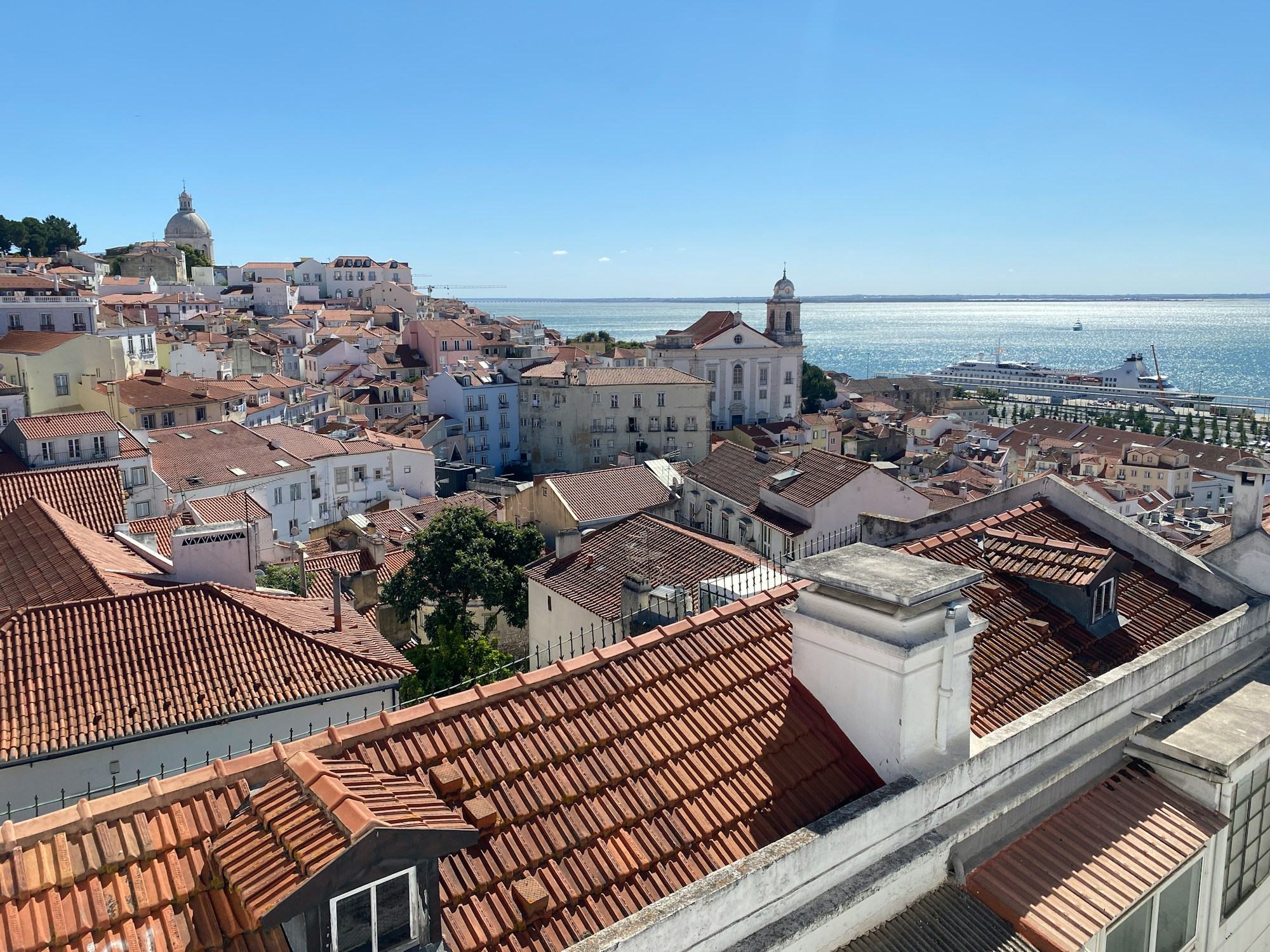
Príncipe Real Daytime — the hilltop neighborhood, botanical gardens, design shops, the cafés that serve espresso at 8 a.m. and wine at 7 p.m., the slow pace of a city neighborhood that isn’t performing for anyone. Tile-fronted buildings. Narrow streets. The miradouro (viewpoint) from the top of the neighborhood looking down across Lisbon’s red roofs to the Tagus River.
Bairro Alto and Alfama Nighttime — the neighborhoods where the bars are, where dinner starts at 9 p.m., where fado music drifts from open doorways, where the city’s nightlife is genuinely queer-integrated (not a separate “gay quarter,” but a city where queer life is visible across neighborhoods). The energy is different from Príncipe Real’s daytime peace.
Both are Lisbon. The rhythm depends on what you want: Are you here for neighborhood peace and morning coffee? Or evening wine and the scene?
Where We’d Anchor
Bairro Alto Hotel (Bairro Alto, central location walking-distance to Príncipe Real) is the contemporary-luxury option — the hotel sits at the intersection of nightlife and neighborhood peace, the design is thoughtful, the bar is where people actually gather. Walk to Príncipe Real in the morning. Walk to the nightlife in the evening. This is the position for balancing both.
Memmo Príncipe Real (literally in Príncipe Real) is the neighborhood-immersion option — a small luxury boutique built into the historic district itself. The location puts you in the neighborhood-café rhythm. You’re not visiting Príncipe Real; you’re living in it.
Tivoli Avenida Liberdade (the grand-boulevard flagship) is the heritage-luxury option — the hotel is Lisbon’s grand-dame address since 1933, the rooftop bar has panoramic city views, the restaurant serves excellent seafood and bacalhau (salt cod, the national dish). The position is on the main avenue, more formal than Príncipe Real’s peace, but with service and heritage.
All three have genuine queer-awareness. Lisbon hotels don’t perform pride; they assume you’re there because you want to be.
The Príncipe Real Walk (An Afternoon)
This is the walk you take on day one, after settling in.
The Botanical Garden (Jardim Botânico da Universidade de Lisboa) sits at the top of the neighborhood — century-old trees, streams, small waterfalls, the kind of quiet green-space intimacy that European botanical gardens do well. Walk slowly. Read. Exist quietly.
Rua Dom Pedro V — the main street through Príncipe Real, lined with independent design shops, bookstores, galleries. This is not shopping as performance; this is browsing. The cafés along the street are where the neighborhood actually gathers — morning coffee, afternoon wine, the shift between morning and evening is gradual and natural.
Pavilhão Chinês — a curiosity-cabinet bar with a labyrinthine interior filled with artifacts, vintage finds, Christmas decorations year-round, the kind of space that feels like it was assembled by someone with specific taste and no regard for conventional design. One of the best bars in Lisbon. Drinks are excellent. The space is the point.
Hello Kristof — coffee, a pastry, the people-watching from a café table. The pace of the neighborhood reveals itself when you’re sitting still.
This walk is an afternoon. It reveals who Príncipe Real is when it’s not performing.
The Bar Layer
Trumps is the institutional gay bar — the place where the city’s queer community actually gathers, where you’ll meet people, where the energy is reliably good. Not a tourist bar. A community bar.
Construction is the party energy (when it’s running) — the collective that hosts the primary weekend queer event. Dates and venues shift; the energy is always excellent.
Príncipe Real café-bars are the place where afternoon shifts into evening — Café Com Calma, Pharmácia (a pharmacy converted to a bar), the small spots where the neighborhood gathers. These are mixed, not segregated-gay, but visibly queer-welcoming.
Bairro Alto nightlife is more mixed — bars, clubs, restaurants, the energy of Lisbon’s nightlife district where queer people are integrated throughout. Not a separate-gay-night thing, but the city moving through evening together.
Lisbon’s nightlife runs late — bars open at 11 p.m., peak at 2 a.m. Dinner at 9 p.m. The rhythm is different from northern Europe or North America.
The Day-Trip Option (Sintra or the Cascais Coast)
Sintra — the cool-microclimate hill town where the Portuguese kings summered. The Pena Palace is the postcard (colorful, romanticist, 19th-century palace on a hilltop). The Quinta da Regaleira is the strange estate with the famous spiral well. A day-trip or an overnight if you want the quieter version.
Cascais — the beach town west of Lisbon, a 20-minute train ride. More casual than Sintra. Beach culture, seafood restaurants, the seaside pace.
Both are easy from Lisbon and don’t require a car if you’re willing to take the train.
What’s Different About Lisbon (Compared to Madrid, Berlin, Tel Aviv)
Lisbon doesn’t have a Pride-as-destination calendar. The city’s queer welcome is sustained, not seasonal. You don’t have to be here in July for Pride to experience the queer culture. You can be here in May or October or February, and the cultural integration is the same.
This is a quieter trip than the Pride-destination ones. You’re not in a crowd of thousands. You’re in a neighborhood where queer life is assumed and celebrated. That’s a different kind of powerful.
Lisbon is also meaningfully less expensive than Madrid or Berlin at every tier, with better weather and food than northern European queer destinations. That changes what’s possible — longer stays, nicer hotels, more meals out, the whole trip feels less like a performance and more like living.
The Fado Conversation
Fado is Portugal’s national music — a genre about saudade (the longing for what is lost or may never be). The Lisbon variant is brighter than the Porto variant (which is melancholic). It’s worth experiencing once, in a small casa de fado (a fado house — a restaurant where musicians perform), with dinner and wine, the room dimmed, the performance intimate.
Don’t do it as a touristy dinner-show. Do it as a real experience at a real casa de fado where locals eat. Mesa de Frades in Alfama, Tasca do Chico in Bairro Alto, Sr. Vinho in Lapa. Reservations are essential.
The Restaurant Layer
Lisbon’s food culture is excellent and approachable — Atlantic seafood, bacalhau in dozens of variations, Portuguese wine that’s genuinely good and not expensive.
Belcanto (2 Michelin stars) — Chef José Avillez, the city’s most celebrated dining room, modern Portuguese.
Alma (1 Michelin star) — Chef Henrique Sá Pessoa, another serious-room option.
Cervejaria Liberdade (not Michelin, but excellent) — Fish and seafood, the casual-serious version of Portuguese food.
Dinner at 9 p.m. Wine. The meal is the evening’s primary event.
How Dandy Plans Lisbon
Lisbon is among the most approachable European queer destinations — flexible in season, meaningfully less expensive than Madrid or London, and welcoming year-round without a single high-demand window that forces your timing. If you’re building a first European queer trip, Lisbon is often the right place to start.
Príncipe Real boutiques (Memmo, the smaller hilltop hotels) book two to three months ahead in the spring and fall shoulder seasons. The Bairro Alto Hotel, with its central position and bar culture, runs slightly deeper. Neither requires the lead-time that Madrid during Orgullo or Berlin during Pride demands.
Dandy typically plans Lisbon as a standalone five-to-seven-day city stay or as part of an Iberian arc: Lisbon plus Porto (a day-trip or an overnight north), or Lisbon plus Madrid (the contrast between the soft welcome and the grand scale), or Lisbon plus Seville for travelers moving through the history of Southern Europe. Any of these pairings works; the choice depends on how much you want to move versus settle.
The fado reservations — Mesa de Frades, Tasca do Chico, Sr. Vinho — should be locked before you arrive. The best houses book quickly.
Lisbon will give you exactly what you’re looking for if you arrive with a sense of what that is. Tell us and we’ll build around it.
Ready to plan your Lisbon? Start a Custom Trip →︎
Be seen. Be celebrated. Be Dandy.
Inspired? Set sail with us.
Eight nights on the Atlantic, with your people.
The Crossing is our flagship voyage — a Dandy group on Queen Mary 2, New York to Southampton, a tableful of Darlings who dress for dinner and mean it.
The CrossingMore from The Society Pages
Three rooms in the house.
See The Voyages
Hosted group departures, curated for the community.
See The VoyagesStart a Custom Trip
Your itinerary, your pace, planned by someone who has done the vetting work.
Start a Custom TripJoin The Society
The monthly dispatch — one a month, no noise. Voyages go to members first.
Join The Society