
Destinations · The Society Pages
Capri: The Original Queer Resort Town
Capri is where queer travelers invented the resort town. For over 140 years. Here's what that history built.
Hello, Darlings.
Capri has been a queer resort destination since the 1880s. Not Miami. Not Fire Island. Not Provincetown. Capri. The island sits off the Sorrentine peninsula in the Tyrrhenian Sea, and for over 140 years, it has been the place where queer travelers went to exist without apology in one of the world’s most beautiful settings.
Norman Douglas wrote South Wind here — the 1917 novel that is, functionally, the first queer novel set at a Mediterranean resort. Compton Mackenzie wrote Vestal Fire and Extraordinary Women about Capri’s lesbian colony. Christian Dior summered. Jacques d’Adelswärd-Fersen built the Villa Lysis in 1905 as a queer-erotic-art sanctuary; the building still stands with the original collection inside. Truman Capote opened Music for Chameleons with a Capri meditation.
The island didn’t become a queer resort because it was discovered. The island was built into being by queer travelers who found a place beautiful enough and expensive enough and far enough from surveillance to create community. The history is not incidental. The history is the place.
The Queer-History Walk (An Afternoon)
This is the walk you take on day two, after the beaches have been enough and before dinner calls you.
Villa Lysis — Jacques d’Adelswärd-Fersen’s 1905 mansion, built to house his private erotic-art collection. Fersen was an exiled French writer and art patron, openly queer, who arrived on Capri in 1899 and built one of the 20th century’s queer-specific art sanctuaries. The building is white and neoclassical, perched on the Faraglioni cliffs with views across the Tyrrhenian. The interior is shocking in its directness — homoerotic sculpture, explicit paintings, a library of texts, all collected and displayed by a man who refused to hide or apologize. Marguerite Yourcenar wrote about him. The Villa Lysis is now a museum; it’s small and intimate and breathtaking in its commitment to aesthetic and queer self-expression.
Villa San Michele — Axel Munthe’s villa, built 1896. Munthe was a Swedish doctor and writer, openly gay, who created a retreat for the artistic and literary queer community. The villa is less explicitly erotic than the Lysis but just as intentional — Greco-Roman sculpture throughout (much of it queer-coded), gardens, the sense of a sanctuary built for a particular kind of person. The interior is now a museum; the whole is a lesson in how queer wealth created space for queer community.
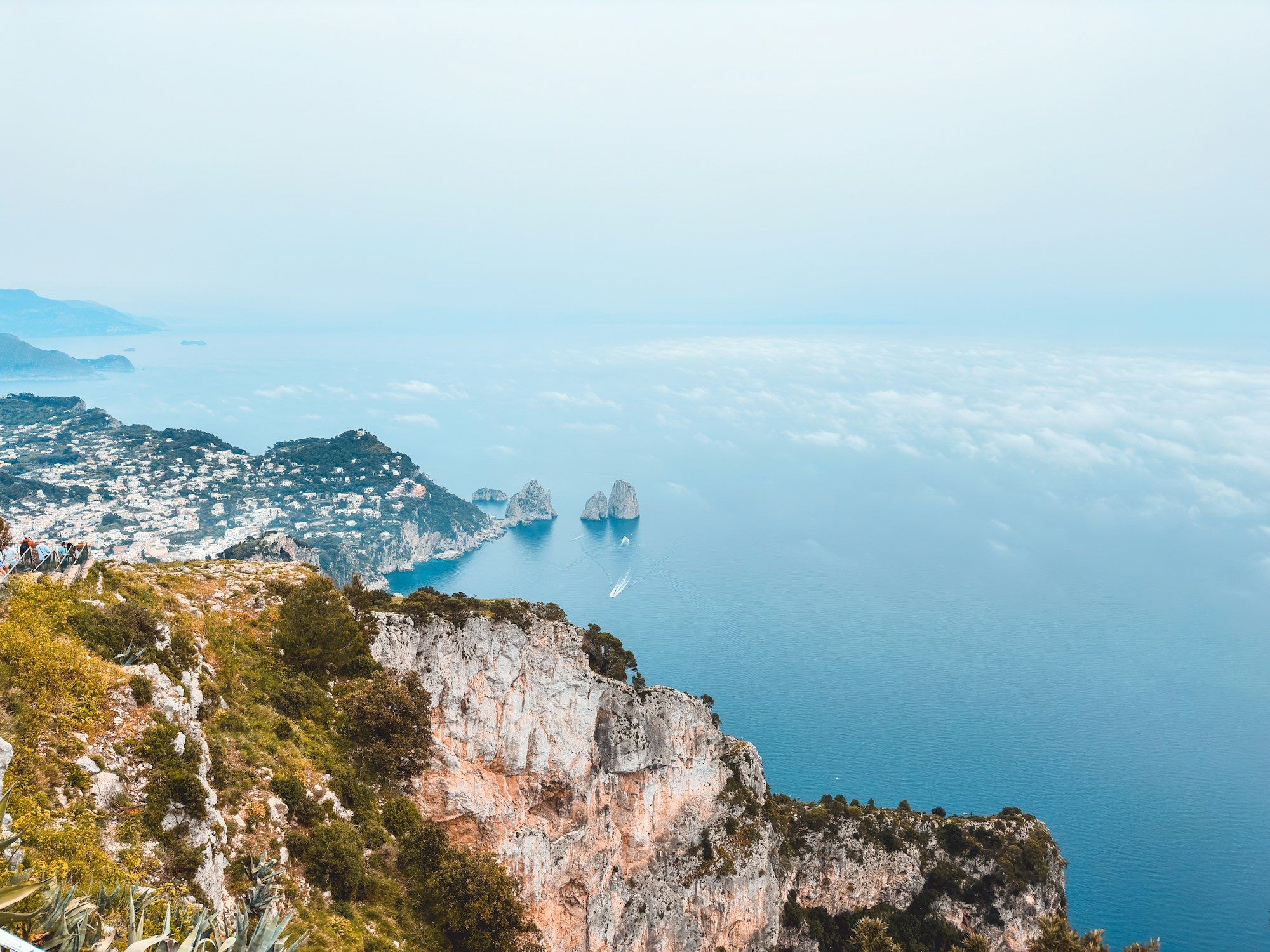
The Faraglioni Cliffs — the three massive sea-stacks that frame the island. In the mid-20th century, queer travelers (mostly men, mostly wealthy enough to rent boats) would charter private gozzi (traditional wooden fishing boats) to swim in the hidden coves beneath the rocks. The Faraglioni rocks became shorthand for queer solidarity — you went there because you knew who else would be there.
The memorial you have to look for — This is the hardest piece. The Nazis murdered many of the German and Austrian queer expats living on Capri. The contemporary plaque honoring them is subtle; you need to know to look. The history is remembered, but quietly.
The walk takes an afternoon. The weight of it takes longer.
Where We’d Anchor
Capri Tiberio Palace (Capri Town center) is the luxury-on-the-piazza option — the position puts you in the center of town life, the rooftop restaurant overlooks the Piazzetta (Capri’s main square, the social center of the island), the service is impeccable. This is where the visible part of the island happens. You’re not remote; you’re engaged.
J.K. Place Capri (cliff-side, between Capri Town and Anacapri) is the contemporary-design flagship — built into the cliffs, the suites are carved stone, the infinity pool appears to spill into the sea, the design is serious and minimal. The position is slightly outside town but not fully in Anacapri; you’re in a retreat rather than town-center. This is the property for travelers who want privacy and design and the visual majesty of Capri without the social theater.
Hotel Punta Tragara (Capri Town, cliff-position) — the property was built as a private villa by Le Corbusier, then converted to a hotel; the architecture is the property’s primary story. The position gives you the cliff-edge panorama but still walking-distance to town. For architecture-minded travelers, this is the call.
All three require intentional choice. Capri Tiberio for the scene. J.K. Place for the retreat. Punta Tragara for the architectural statement. The right choice depends on whether you want Capri’s social life or Capri’s visual majesty — and yes, you can have both, but one will be the priority.
The Day Rhythm (How the Island Actually Moves)
Morning — Breakfast at the hotel or a café on the Piazzetta. Coffee. Pastry. Read. Move slowly.
Late morning — Boat day. Hire a gozzo with skipper (essential; do not rent without a skipper) and spend three hours exploring the sea-stacks, the hidden coves, the Blue Grotto (weather permitting). Swim in the water. Exist quietly.
Lunch — La Fontelina or Da Luigi ai Faraglioni — the two legendary clifftop restaurants with tables overlooking the sea and the Faraglioni. Order the totani (squid), the branzino (sea bass), the light white wine. Lunch is slow; it’s 2–3 hours of eating and conversation.
Afternoon — Return to the hotel. Shower. Siesta. Read in a quiet room.
Late afternoon — Walk the town. Piazzetta aperitivo. Walk to a viewpoint. Watch the light change on the water. Exist visibly if you want it, quietly if you don’t.
Dinner — Da Paolino (the iconic restaurant in a lemon grove with lights suspended through the trees — the Capri experience in a dining room), or Lo Smeraldino (the authentic Italian restaurant away from the tourist center). Dinner at 8:30 p.m. Italian pace. Conversation. Wine. The rest of the evening unfolds from there.
The pacing is built to reward slowness. Capri is not a do-list island. Capri is a be island.
The Restaurant Layer
Da Paolino is the must-experience — the dining room is literally in a lemon grove, with Edison-bulb lights strung through the trees, the sense of eating in an enchanted garden. The food is Italian-Mediterranean, the plates are beautiful, the whole experience is the most Capri-experience available. Expensive. Worth every reservation battle. Book weeks in advance and don’t miss it.
La Fontelina and Da Luigi ai Faraglioni are the lunch destinations — clifftop positioning, sea views, the totani and the branzino are the staples. These are not formal; they’re long and leisurely.
Lo Smeraldino is the authentic Italian option — away from the tourist center, where Caprese people actually eat, the menu is seasonal and local, no tourists perform here. This is the real version.
Capri Town vs. Anacapri (The Choice)
Capri Town is polished — the Piazzetta, the shopping, the social theater of being seen. Stay here if you want to be part of the island’s visible life.
Anacapri is quieter — higher elevation, less densely trafficked, the chairlift up Mount Solaro gives you views across the Bay of Naples. More residential. The Villa San Michele is here. Stay here if you want Capri’s beauty without the social density.
The right answer depends on whether you’re traveling as a couple seeking intimacy (Anacapri, a private villa hotel) or as part of a friend group seeking community (Capri Town, the Piazzetta energy). Dandy knows the difference.
The Seasonal Awareness
May and September are the best months — warm, fewer crowds than June-August, the light is excellent, the pacing is slower. The island is itself rather than performing for summer tourists.
June, July, August are peak — hot, expensive, the island is at maximum capacity. The energy is there if you want it, but you’re sharing the experience with thousands of others.
April and October are manageable — warm enough to swim, fewer people, the island’s actual rhythm is visible.
November–March — many restaurants and hotels close. The island feels abandoned. Don’t.
The Queer History as the Point
Here’s what makes Capri distinct from other Mediterranean resort islands: the queer history is not hidden or incidental. Villa Lysis exists. It’s a museum. The history is curated. The contemporary island remembers who built it and what they were building.
Other islands have queer travelers. Capri was built by them. The architecture, the restaurants, the social infrastructure — all of it emerged from a century-plus of queer travelers creating community. The island doesn’t apologize for that history. It celebrates it.
That changes what it means to be there. You’re not a queer traveler visiting a beautiful island. You’re a queer traveler returning to a place your community built.
How Dandy Plans Capri
Capri is small and books accordingly. May and September are the windows — the island is at its most beautiful and the best properties still have availability if you move three to five months ahead. July and August are maximum season: extraordinary and crowded and expensive, in that order.
The boat day (hiring a gozzo with skipper) should be secured before you arrive. The best skippers fill out weeks ahead in-season. Dandy handles this as part of the booking, not an afterthought.
Da Paolino reservations should be made before you book your flights. If your target dates don’t have a table, work backwards to dates that do. The lemon grove is the point.
Capri works beautifully as a three-to-four-day anchor in a larger Italian arc: Naples and the Amalfi Coast, then Capri, then Rome moving north — or Capri as a standalone long-weekend escape from the Italian mainland. The island rewards time over logistics; a rushed day trip from the mainland will give you an impression. Three nights gives you the place.
Dandy has traveled this island with intention. We know the right skipper, the right table, the right property for the kind of trip you’re building.
Ready to plan your Capri? Start a Custom Trip →︎
Be seen. Be celebrated. Be Dandy.
Inspired? Set sail with us.
Eight nights on the Atlantic, with your people.
The Crossing is our flagship voyage — a Dandy group on Queen Mary 2, New York to Southampton, a tableful of Darlings who dress for dinner and mean it.
The CrossingMore from The Society Pages
Three rooms in the house.
See The Voyages
Hosted group departures, curated for the community.
See The VoyagesStart a Custom Trip
Your itinerary, your pace, planned by someone who has done the vetting work.
Start a Custom TripJoin The Society
The monthly dispatch — one a month, no noise. Voyages go to members first.
Join The Society